Chapter Six
Five ideas to carry with you
{{pg.lead}}
{{pg.bold}}
{{pg.big}}
— {{pg.sign}}
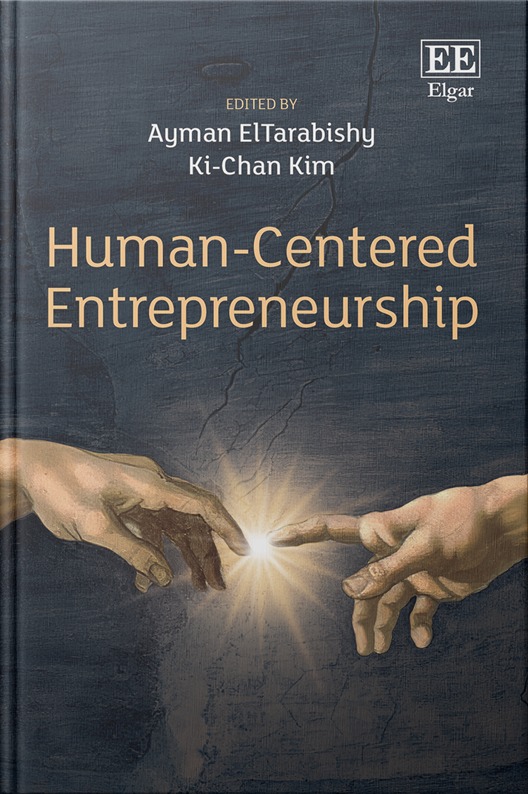
Human-Centered Entrepreneurship
ElTarabishy & Kim · Edward Elgar
Chapter 6
Luca Iandoli, Cecilia Chirieleison, and Teresa Turzo
What this chapter is about
The Three E’s stay good intentions until you design them into daily work.
If your values are on the wall but not in the work.
You’ll get a practical cycle for building them in.
If you are starting something and the future refuses to be predicted.
You’ll see why making and testing beats forecasting.
If you teach entrepreneurship and want students to build, not just plan.
You’ll get the case for a pedagogy of making.
If you run a lab, a makerspace, or a team that never quite gels.
You’ll see the three conditions that make it work.
From the book · the opening pages
Thinking begins in a forked-road situation, a situation that is ambiguous, which presents a dilemma, which proposes alternatives.John Dewey
How does an organization actually build the cultural conditions for Human-Centered Entrepreneurship (HCE)? How do Empathy, Enablement, and Empowerment move from framework principles into the daily decisions, routines, and structures of a firm? This chapter answers that question through design reasoning. Drawing on Herbert Simon’s sciences of the artificial and the Exploration–Interpretation–Consolidation cycle, it argues that design is the operational practice through which HCE principles become organizational reality, and that organizations unable to build this practice will find that the Three E’s remain aspirational rather than structural, producing precisely the compliance-without-capability failure mode the HCE framework identifies.
Figure 6.1, made interactive
Design work moves through three phases, again and again. Each phase is where one of the Three E’s shows up in practice. Choose a phase, or step around the cycle.
{{cur.e}} in practice
{{cur.name}}
{{cur.what}}
Tools: {{cur.tools}}
{{cur.test}}
Try it on your own work
{{cur.ask}}
Putting it to work
The chapter names three conditions that must work together. Switch one off to see what the chapter says happens.
{{verdict.label}}
{{verdict.title}}
{{verdict.text}}
01
Prototypes, business models, and stories turn assumptions into things people can react to. Each version teaches more than a forecast.
02
Every iteration asks three questions together: can we build it, do people want it, and is it right?
03
Profit and growth tell part of the story. Add well-being, purpose, waste reduction, and environmental impact.
What comes next The chapter points to artificial intelligence: as software makes more decisions, the same humane principles will have to be designed into the algorithms.
Chapter Six
{{pg.lead}}
{{pg.bold}}
{{pg.big}}
— {{pg.sign}}
Turn the page
Iandoli, L., Chirieleison, C., & Turzo, T. (2027). Design-driven human-centered entrepreneurship: A strategic management perspective. In A. ElTarabishy & K.-C. Kim (Eds.), Human-Centered Entrepreneurship (pp. 85–98). Edward Elgar Publishing.