Preview edition
The opening pages of all eighteen chapters, with praise for the book, a preamble by Ban Ki-moon, and the story behind it. Free to read here or download.
Download the preview edition PDF · 26 pagesOrder the book
Praise for the book
‘Human-Centered Entrepreneurship reframes entrepreneurial endeavors around empathy, enablement, and empowerment. Ayman and Ki-Chan, through a series of diverse global cases, underscore the importance of society’s most important asset - people - across ancient wisdom, modern practices, and the age of innovation. The book is an insightful reference that offers in-depth evidence that people-first, value-based enterprises not only perform better but also endure, thrive, and help transform societies.’
‘This book is excellent because it combines rigor with real-world usefulness. ElTarabishy and Kim show that empathy, enablement, and empowerment aren’t feel-good ideas — they actually drive MSME performance across cultures. This book is a genuine bridge between theory and practice, built on evidence, not wishful thinking.’
‘Human-Centered Entrepreneurship makes a compelling case that lasting business success starts with investing in people. Grounded in research and rich with real-world examples, it offers an inspiring framework for building stronger organizations and a more sustainable economy.’
Preamble
To Ki-Chan Kim and Ayman ElTarabishy, together with the members of the International Council for Small Business Board and all participants of the International Council for Small Business Conference.
We are now well into the first year of the 2030 Agenda for Sustainable Development, our transformative plan to ensure a life of dignity for all. The ambitious Sustainable Development Goals call for policies that encourage the growth of small and medium-sized enterprises, because these businesses can help create a more sustainable world, with better jobs, greater respect for the environment, and more inclusive societies.
I hope you will find creative ways for small businesses to help achieve the Sustainable Development Goals. The United Nations fully supports your efforts to act responsibly toward the societies in which you operate and to help create a better future for all.
In this spirit, I wish you great success.
Ban Ki-moon
Excerpt from congratulatory remarks delivered at the International Council for Small Business Conference, United Nations, June 2016, and reproduced with permission.
The story behind the book
In September 2015, Ki-Chan Kim and Ayman ElTarabishy were in Seoul, driving to dinner and talking about Pope Francis's visit to the United Nations. Somewhere on the way, Ayman blurted out, "Humane Entrepreneurship." Ki-Chan smiled. "I like it."
Read the full story →Contents
Only 33 percent of adults, based on the median across countries surveyed globally by Gallup, are thriving. In this context, thriving means believing that life is going well today and that the future will be even better. By this measure, barely one-third of adults reach that threshold. Work tells a similar story. Gallup’s earlier research found that only 27 percent of adults held what researchers define as a real job: stable employment of at least 30 hours per week with an employer. Even among those working, only 21 percent report being genuinely engaged in their work.
These statistics represent lived realities. A 54-year-old factory supervisor in Ohio who has worked for 30 years and cannot name a single thing about his job that matters to him. A 28-year-old graduate in Cairo with a degree she cannot use, applying for the hundredth position and never hearing back. A 19-year-old in Jakarta juggling three temporary jobs just to make ends meet, without steady employment, a sense of belonging, or a clear path toward a secure future. A 67-year-old entrepreneur in Buenos Aires who built something real and now watches her grandchildren refuse to join because they cannot see a future for themselves in it. These are not statistical abstractions. They are the human reality behind the numbers, and the reason this book exists.
Behind the statistics lies something deeper: the quiet erosion of hope. By any honest measure, these people are not thriving. Let us call it what it is. Economic growth has expanded. Human flourishing has not.
The organizations that put people at the center did not just perform better. They endured.
Read chapter 1 →
In The Merchant of Venice (1600), Shakespeare captures a truth that still defines modern leadership: knowing what is right is far easier than doing it. It is a truth as uncomfortable as it is enduring. If knowledge alone were enough, organizations would already be human-centered, but they are not. Despite decades of frameworks, values statements, and leadership principles, a wide gap remains between what is understood and what is practiced. This gap between understanding and action is not incidental; it is the central challenge this chapter confronts in the context of Human-Centered Entrepreneurship (HCE). As the Roman poet Ovid observed long before Shakespeare, we may recognize and approve the better course yet still follow the worse (Ovid 2004, Book VII, lines 20–21).
The answer lies in principles. Values alone do not guide behavior. Principles do. Values declare intent, but principles determine action, especially under pressure and uncertainty when trade-offs are unavoidable. In those moments, organizations reveal what they truly stand for. Principles provide direction when rules fall short, and competing priorities collide. Without them, values become inconsistent and are easily overridden. Principles are what turn humanitas, the foundation of human-centeredness, into something that can be practiced in real decisions.
Values declare intent. Principles determine action.
Read chapter 2 →
Shakespeare in The Merchant of Venice names an enduring problem: it is easier to know what is good than to do it. Human-Centered Entrepreneurship (HCE) is not exempt from this challenge. The Three E’s of Empathy, Enablement, and Empowerment, integrated with the entrepreneurial dynamism of Innovation, Risk-Taking, and Proactivity, constitute a compelling framework. But a framework understood is not a framework embodied. Principles bridge the gap between values and action; they translate leadership vision into organizational culture and culture into behavior that serves human flourishing. Yet even this is incomplete. Principles require a particular kind of person to carry them. Knowing what principles demand is not the same as having the character to live by them under pressure.
When principles erode in organizations, the failure does not happen all at once. It cascades. It begins in the character of leaders, in the gradual displacement of principled judgment by short-term pressures or personal ambition. It then manifests in interpersonal behavior: actions contradict stated values, trust collapses, and those with genuine commitment disengage. Finally, it becomes embedded in organizational culture, where operative assumptions quietly shift from serving human flourishing to optimizing measurable outputs. Each level reinforces the others in a vicious cycle. Understanding where principles fail is essential. But the more important question is developmental: what kind of person resists this cascade? What must they cultivate in themselves, in their relationships, and in the cultures they build?
No organization can be more human-centered than its leader’s character permits.
Read chapter 3 →
The worth of a state, in the long run, is the worth of the individuals composing it.John Stuart Mill
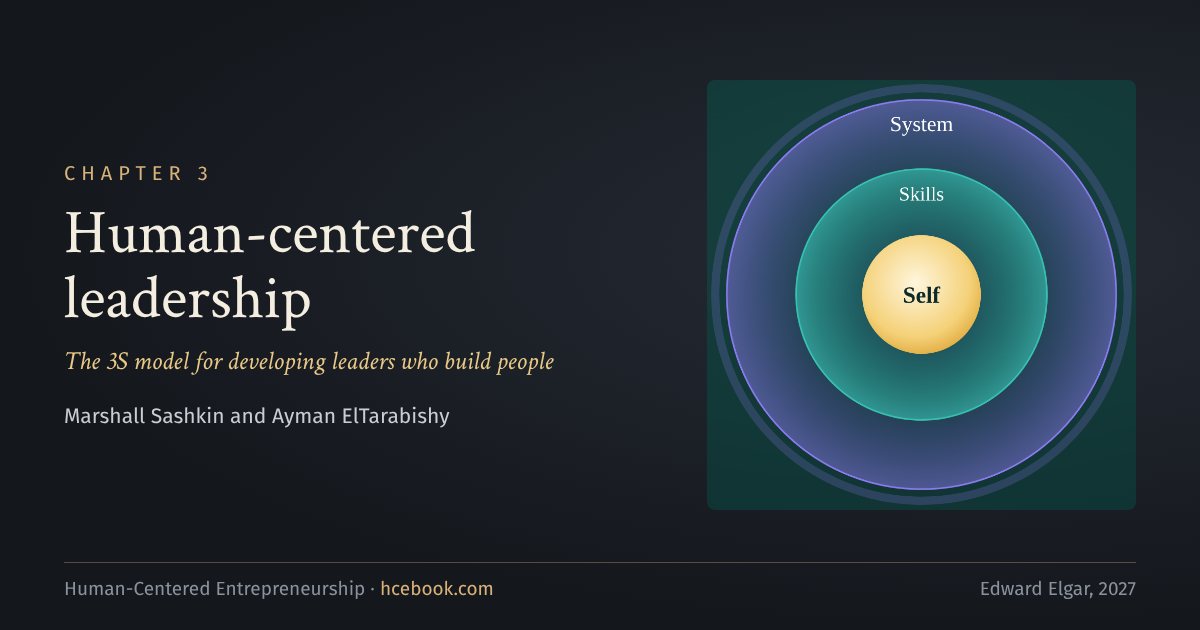
Human-centered leaders develop the Self, Skills, and System through which HCE becomes operational at the individual and organizational level. Those leaders do not operate in a vacuum. They lead small and medium-sized enterprises facing a specific set of systemic pressures, and how those organizations navigate them strategically and translate their human-centered values into a durable competitive advantage is the subject of this chapter.
Traditional notions of value creation are under threat in the contemporary business world due to the concurrent convergence of social divisions, governance challenges, climate challenges, and digital transformation. The limitations of Milton Friedman’s (1970, 2007) profit-maximization rule have become evident and pose a significant problem amid the unprecedented global change of the last 25 years. Opportunities and crises arise from this convergence, necessitating new entrepreneurial approaches that can navigate complexity while delivering tangible value.
Profit or purpose was never the real choice. Keeping them apart was the mistake.
Read chapter 4 →
The art of progress is to preserve order amid change and to preserve change amid order.Alfred North Whitehead, Adventures of Ideas (1933)
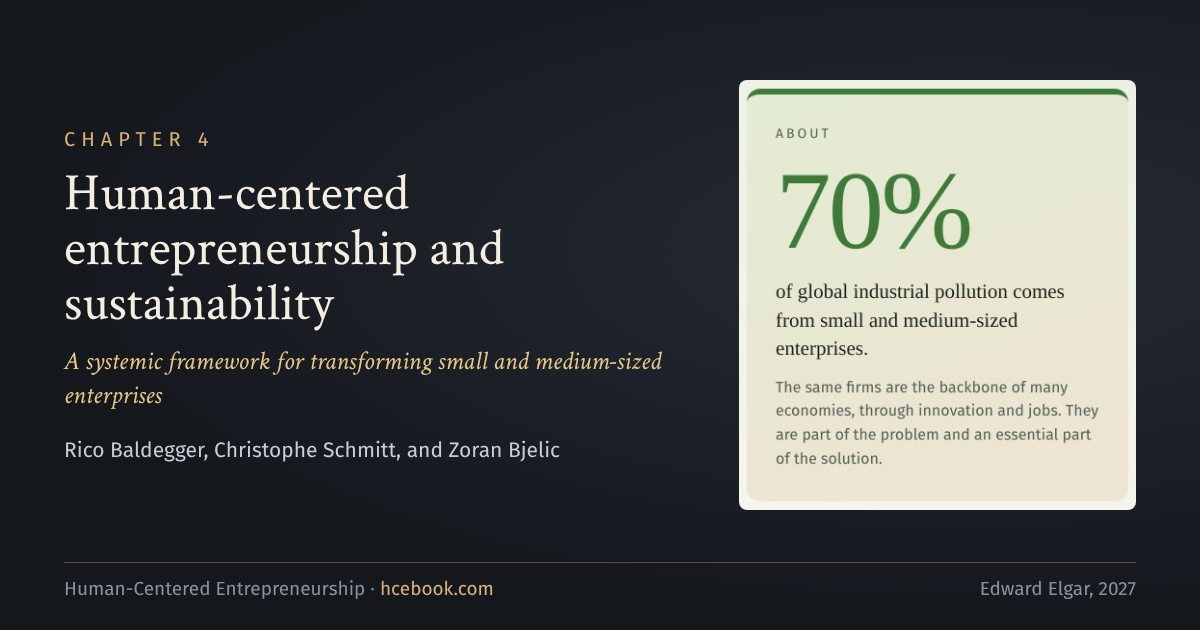
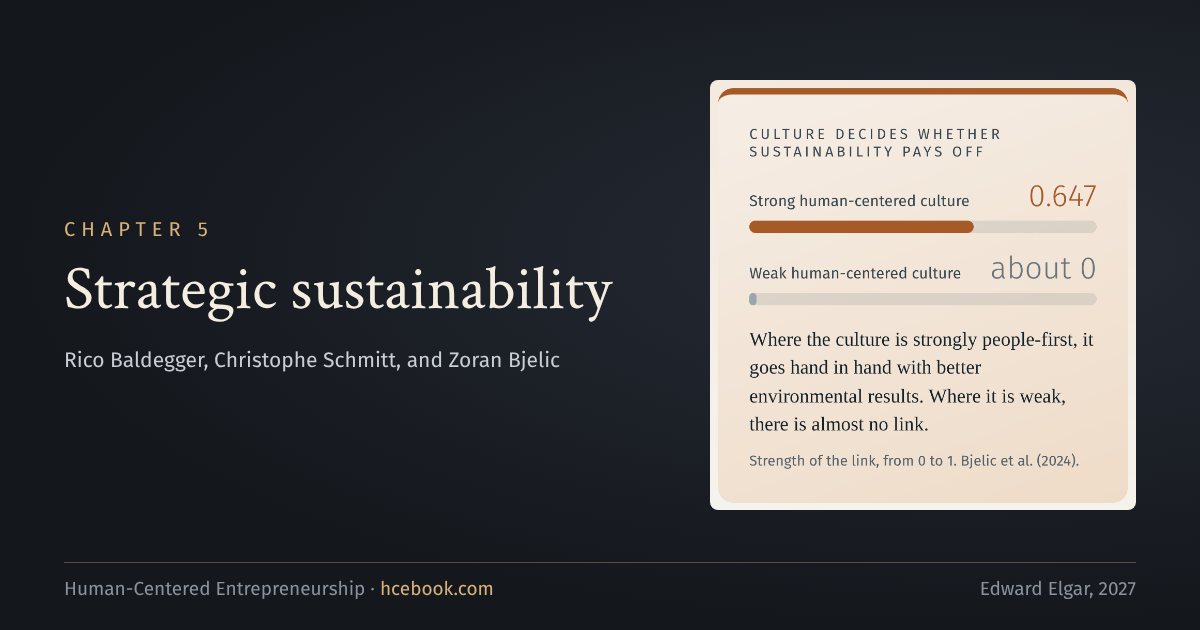
Prior research has established what Human-Centered Entrepreneurship (HCE) is: a systemic approach that distinguishes itself from CSR, eco-entrepreneurship, and sustainable entrepreneurship by embedding the Three E’s (Empathy, Enablement, and Empowerment) into the organizational core rather than appending them to peripheral initiatives. It has demonstrated, drawing on the Bjelic et al. (2024) study and complementary evidence, that SMEs embodying this orientation achieve measurable improvements in financial, social, and environmental outcomes. Having established the “what” and the “why,” this chapter addresses the “how.” Specifically, it asks: through what organizational mechanism does commitment to the Three E’s and SDG-aligned sustainability translate into durable competitive advantage? The answer lies in dynamic capabilities; the ability to sense opportunities and threats, seize them through innovation and resource mobilization, and reconfigure organizational assets as conditions change (Teece et al., 1997). HCE, this chapter argues, is both the transmission mechanism that converts sustainability intentions into these capabilities and the cultural amplifier that determines how powerfully that conversion occurs. Understanding this machinery is essential for practitioners who want more than inspiration; they need a blueprint for making sustainability strategic. The 3S model identifies the developmental architecture through which leaders build this capacity: Self, Skills, and System. This chapter demonstrates what those levels produce at the organizational scale when commitment to the Three E’s aligns with SDG-aligned sustainability as the operating context.
Sustainability without a human-centered culture buys compliance. With it, sustainability builds capability.
Read chapter 5 →
Thinking begins in a forked-road situation, a situation that is ambiguous, which presents a dilemma, which proposes alternatives.John Dewey
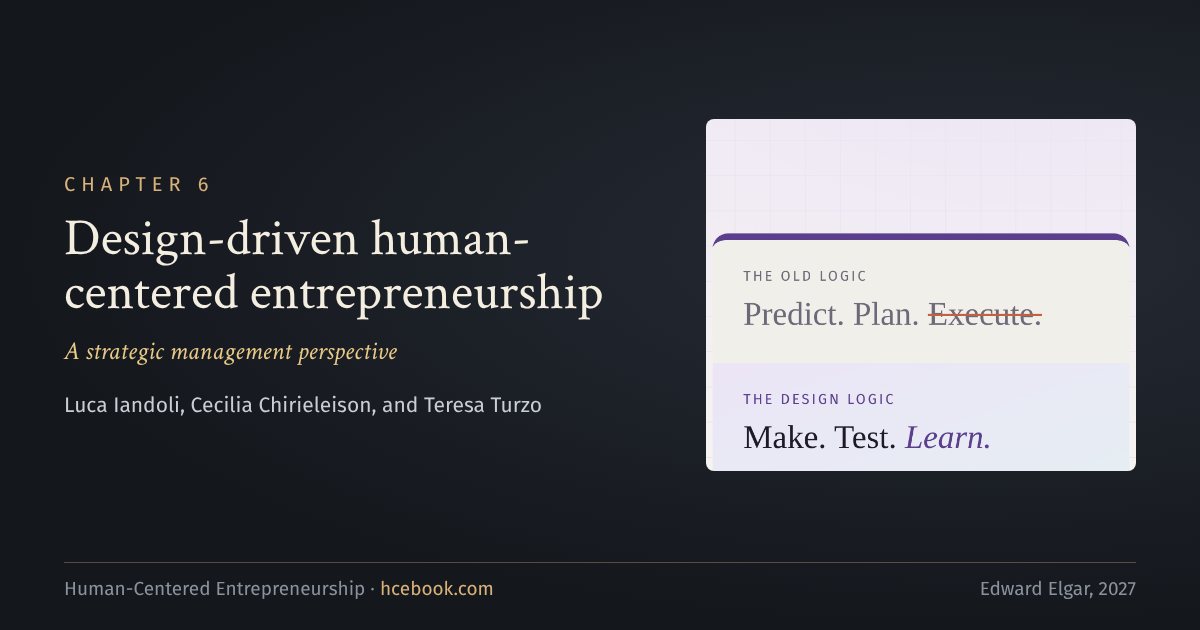
How does an organization actually build the cultural conditions for Human-Centered Entrepreneurship (HCE)? How do Empathy, Enablement, and Empowerment move from framework principles into the daily decisions, routines, and structures of a firm? This chapter answers that question through design reasoning. Drawing on Herbert Simon’s sciences of the artificial and the Exploration–Interpretation–Consolidation cycle, it argues that design is the operational practice through which HCE principles become organizational reality, and that organizations unable to build this practice will find that the Three E’s remain aspirational rather than structural, producing precisely the compliance-without-capability failure mode the HCE framework identifies.
The Three E’s stay good intentions until you design them into daily work.
Read chapter 6 →
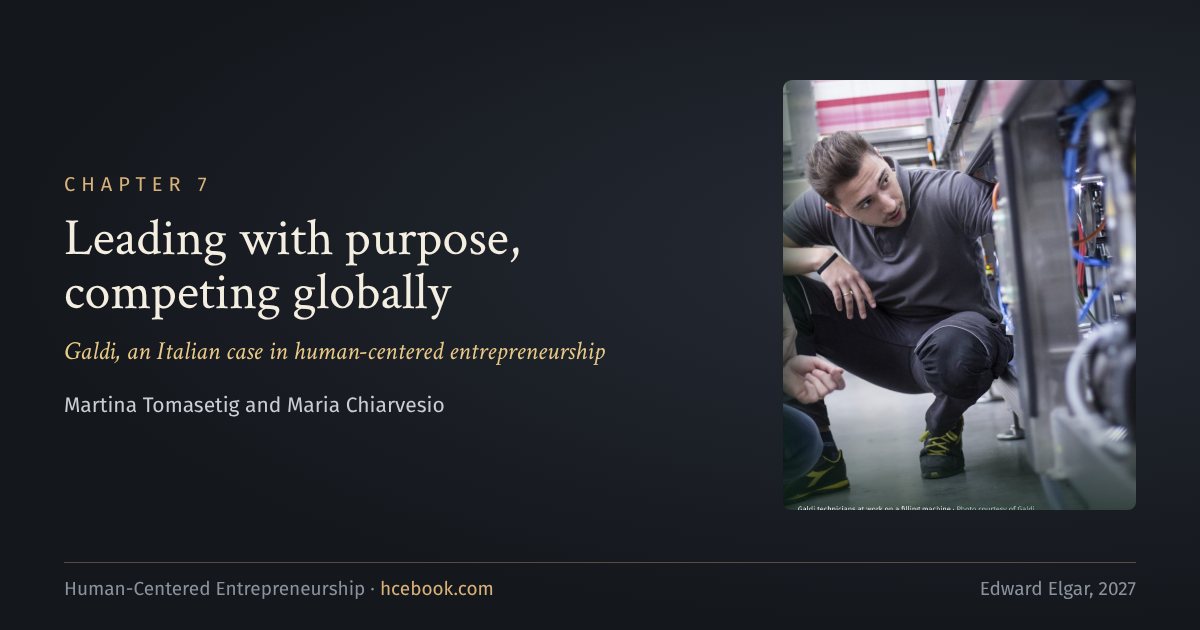
Galdi is an Italian producer of packaging machinery: a firm whose entire business is the design of how things are contained, protected, and delivered to the world. However, look closer, and the design logic runs deeper than the product. At the organizational level, Galdi has spent a decade designing how HCE principles are built into the daily structure of work, giving Empathy, Enablement, and Empowerment actual shape and function rather than leaving them as aspirational language. At the level of jobs themselves, Galdi has designed what work looks like for 130 people in a technically demanding, globally competitive manufacturing sector: not as a cost to be minimized but as a site of human flourishing. Three layers of design operate simultaneously: product design, organizational design, job design.
The case that follows is the story of how a firm that packages liquid for the world’s food supply learned, in the same motion, to package human dignity into the conditions of daily work, and found that doing so made it more competitive, not less.
Galdi packages milk for the world. It learned to build dignity into daily work, and became more competitive, not less.
Read chapter 7 →
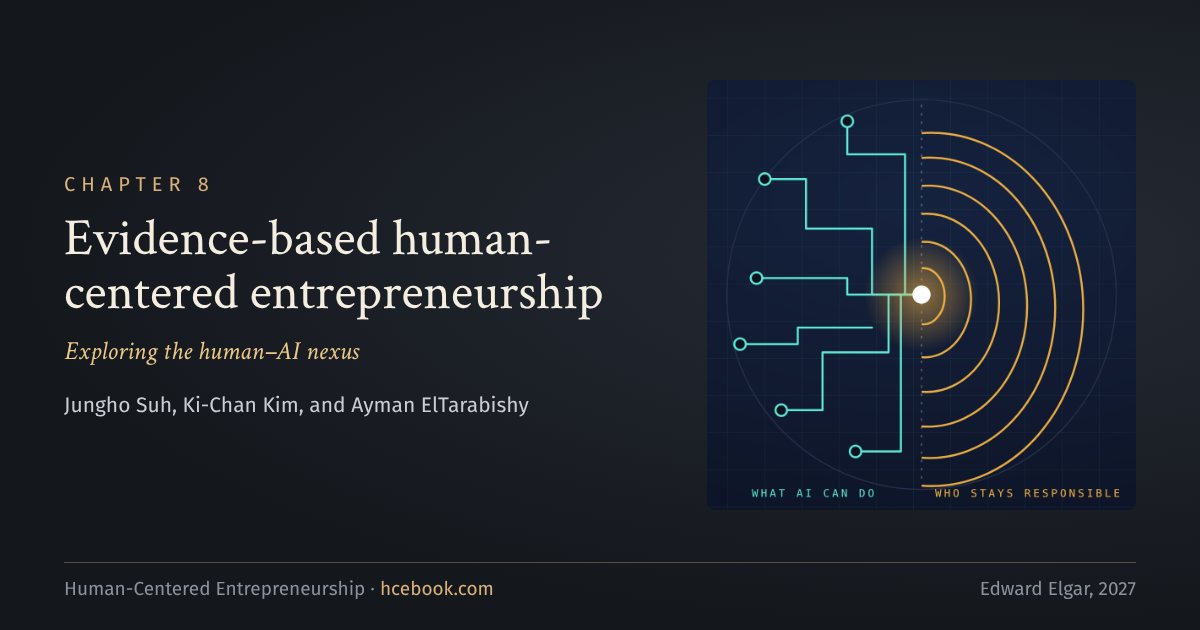
Human-Centered Entrepreneurship (HCE) has been demonstrated across manufacturing, services, and institutional contexts where technology serves rather than displaces human relationships. This chapter enters a different arena, one in which the technology itself is the subject of contest. Artificial intelligence does not merely alter how work is done; it challenges the premise that human judgment, empathy, and ethical reasoning remain central to entrepreneurial practice. The tension between what technology can do and what people must remain responsible for is sharper here than in most entrepreneurial contexts. The answer the evidence points toward, however, is consistent with the broader HCE literature: the Three E’s do not bend to the technology of the era.
AI changes how work is done. The Three E’s do not bend to it. They hold.
Read chapter 8 →
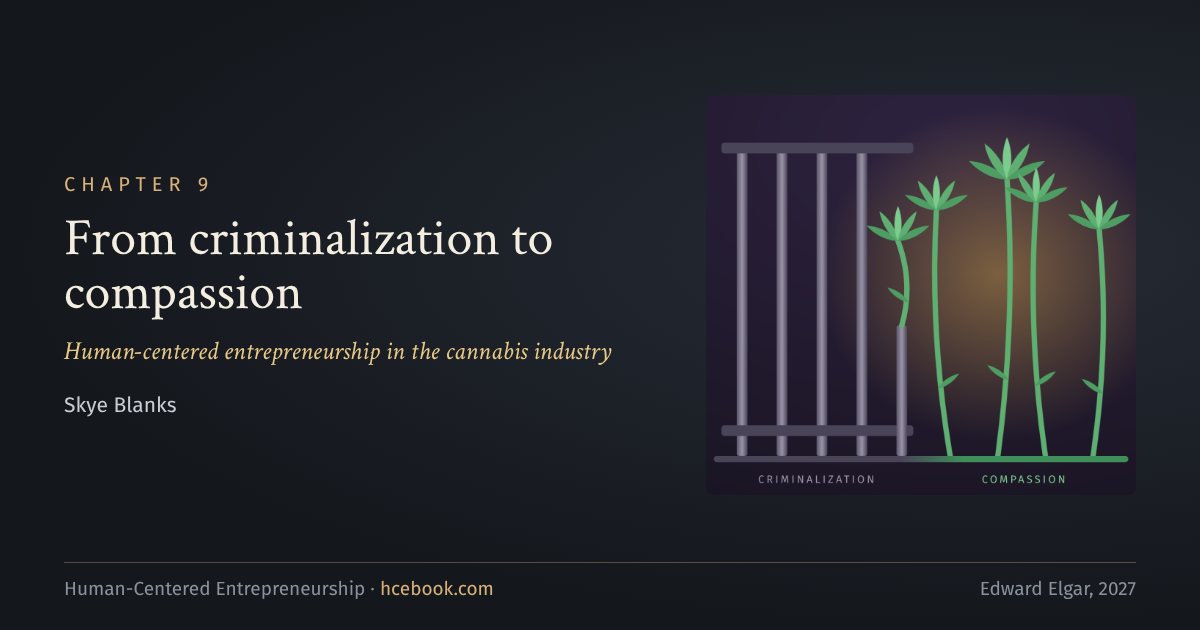
Premo Cannabis Company, founded in 2022 in Keyport, New Jersey, is, in many ways, a story about fathers and sons and about what one generation owes the next. My father, Donald Blanks, and I joined forces with Darrin Chandler Sr. and Darrin Chandler Jr., who brought expertise from Colorado’s established cannabis market, to build one of the first successful Black-owned recreational dispensaries in New Jersey. However, to understand what Premo is and why it matters, you have to understand what I watched growing up.
I grew up watching my father navigate the intersection of ambition and systemic exclusion. My father had spent decades building businesses and community relationships, understanding from the inside how the American economic system simultaneously invited and obstructed Black entrepreneurship. When cannabis legalization arrived in New Jersey, he did not see a conventional business opportunity. He saw a moral imperative: here was an industry built on the criminalization of communities like our own, now suddenly legal and lucrative, and the people most harmed by its prohibition were being systematically locked out of its benefits.
The people most harmed by the War on Drugs are often locked out of the legal cannabis industry. One Black-owned dispensary shows that putting them first is good business, not charity.
Read chapter 9 →
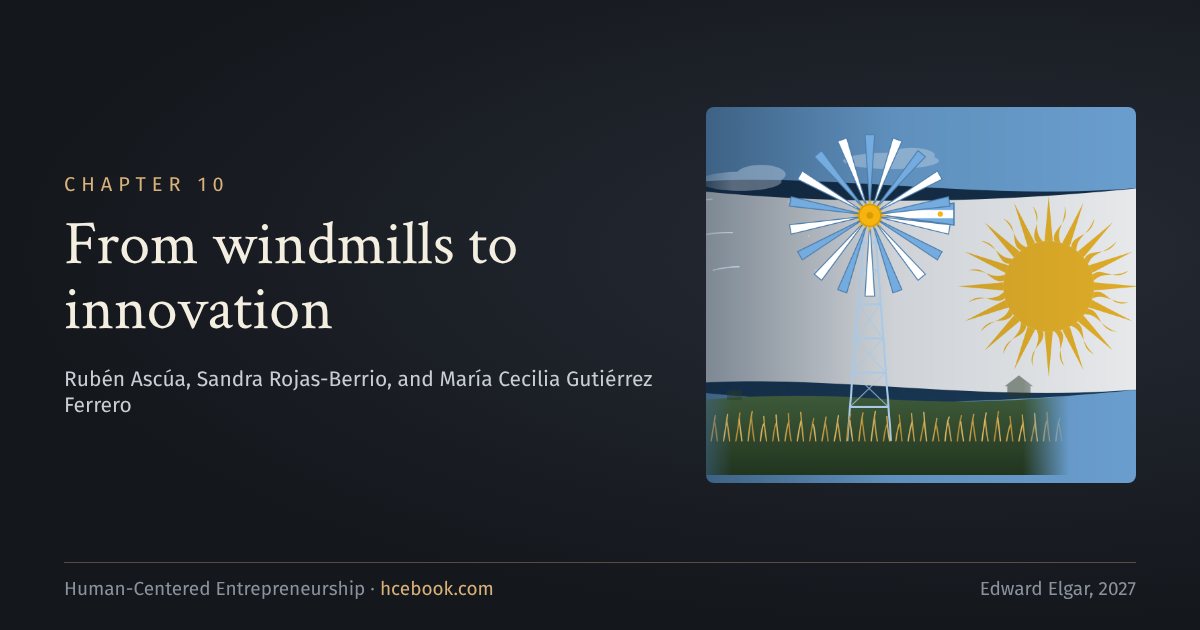
The university’s logo refers to the region’s heritage, represented by a windmill, a technology recognized as a symbol of human labor on the vast plains inhabited by immigrant settlers in the late nineteenth century. The windmill enabled groundwater extraction with no energy other than the wind, which is frequent on the Argentine plains. The availability of water enabled the establishment of rural livestock and crop enterprises that later led to industrial development. The windmill is a symbol of progress. The technology contributed to the development of hardworking communities that organized themselves to promote associations and institutions, with education as a fundamental pillar (Institutional Development Plan, 2017).
Far from being a nostalgic decoration, the windmill represents a technology that, since it arrived on the Pampas in 1880, has transformed arid plains into productive settlements by harnessing wind power. In UNRaf’s identity, the windmill symbolizes technology serving human development. This catalyst transforms knowledge into real prosperity, allowing the university to function as an academic startup while remaining deeply rooted in the region’s tradition of cooperation.
A new public university on the Argentine plains ran itself like a startup, built on the Three E’s. In under ten years it grew from 194 students to 3,794.
Read chapter 10 →
Into this crisis stepped Kim Seong-han, a 30-year insurance industry veteran whose previous career at Kyobo Life Insurance, one of Korea’s largest and most respected insurers, had provided deep technical expertise and strategic perspective. But Kim brought something more significant than conventional industry knowledge: a fundamentally different philosophical approach to leadership that would reshape every aspect of DGB’s operations. His approach, which he termed “humane management,” aligned precisely with HCE principles. Rather than beginning with cost-cutting, restructuring, or strategic repositioning, the standard turnaround playbook, Kim started with a different question: How do we build an organization where people want to give their best?
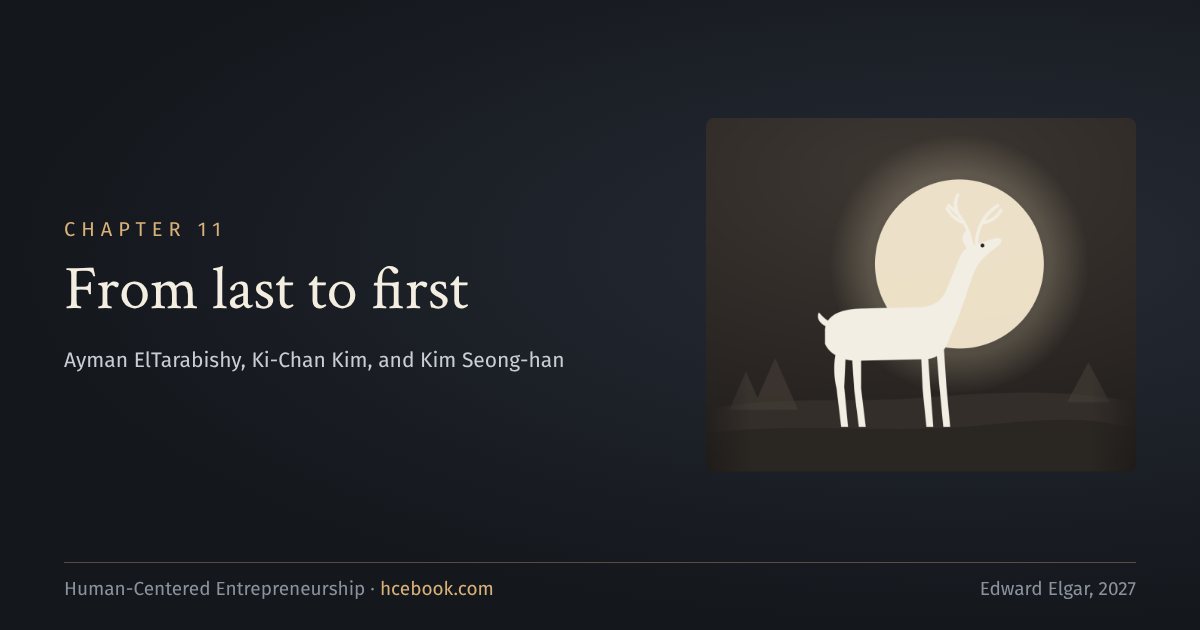
Kim embodied what he called the Nokmyeong philosophy within the organization. Derived from the Chinese classic Shijing (Book of Songs), Nokmyeong refers to the cry of a deer when it discovers food, a sound that calls other deer to share in the find. This behavior symbolizes natural empathy grounded not in competition but in mutual sharing and understanding. The philosophy challenged the zero-sum thinking that had dominated DGB’s culture, where one person’s success was implicitly another’s failure. Kim used this imagery repeatedly in communications, modeling, and organizational design to establish a fundamentally different cultural assumption: at DGB, we succeed together or not at all.
From the Shijing (Book of Songs). At DGB it meant one thing: we succeed together or not at all.
In 2020, DGB Life ranked last of Korea’s 22 life insurers. Its new CEO started with trust, not cuts. Four years later it was among the fastest-growing in the country.
Read chapter 11 →
South Korea’s economic transformation stands as one of the most remarkable stories in modern history. In 1960, the nation’s GDP per capita was lower than that of many sub-Saharan African countries. Today, South Korea ranks among the world’s most prosperous economies, home to global giants like Samsung, LG, and Hyundai, as well as dozens of other companies that have reshaped industries from electronics to shipbuilding to entertainment. Economists have offered many explanations for this “Miracle on the Han River”: strategic government policy, export-oriented industrialization, investment in education, and favorable international trade conditions. Each explanation captures part of the truth. However, something deeper remains unexplained.
Why Korea? Other nations received similar foreign aid. Other governments pursued export-led growth strategies, and different societies invested heavily in education. Yet few achieved Korea’s extraordinary combination of rapid economic growth, technological innovation, and sustained global market leadership.
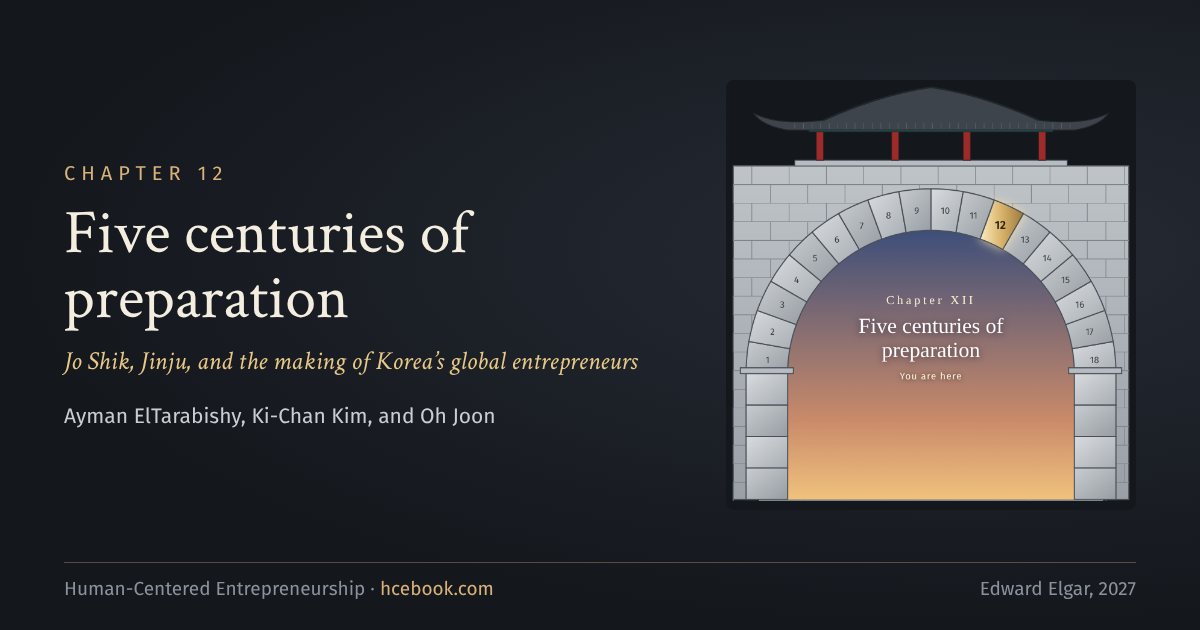
In this chapter, we argue that the missing explanation lies five centuries in the past, in the teachings of a Confucian philosopher who never sought government office and who died 400 years before Samsung was founded.
Jo Shik died in 1572. Samsung was founded in 1938. The chain never broke.
Read chapter 12 →
Walk into any souk in the Arab world, in Marrakech or Damascus, in Cairo or Muscat, and you will find something that no business school has ever successfully taught: commerce as relationship. The merchant does not begin with the price. He begins with the greeting, the tea, the question about your family, and the unhurried recognition of you as a person before you are a customer.
This is not inefficiency. It is not a charm deployed for commercial advantage. It is a civilization’s understanding, expressed in 10,000 daily transactions, that the human connection is the precondition of the economic one, that trust is not a means to trade but its foundation, and that the dignity of the person across the counter is not a courtesy to be extended but a premise to be honored.
The merchant does not begin with the price. He begins with the greeting.
Read chapter 13 →
In 2015, the international community did something remarkable: it brought 193 nations together around a shared commitment to human flourishing, encapsulated in 17 Sustainable Development Goals (United Nations, 2015). I was in the room. I served as the 71st President of the United Nations Economic and Social Council when the 2030 Agenda was adopted. I introduced the ECOSOC report to the General Assembly one month later. What I describe in this chapter – the ambition, the shortfall, and the structural reasons why only 17 percent of SDG targets are currently on track – is the institutional context into which Human-Centered Entrepreneurship (HCE) must be placed. The SDGs are the world’s most ambitious attempt to operationalize the Human Era. This chapter answers why that attempt requires HCE to succeed.
Over the past decade, one of the most frequently used words in the international community has likely been “sustainable.” It is commonly used in contexts such as “sustainable development” and “sustainable future.” The 1987 UN report Our Common Future1 (Brundtland Commission, 1987) introduced the concept of sustainable development, defining it as “development that meets the needs of the present without compromising the ability of future generations to meet their own needs.” While sustainable development has become a familiar term, a closer look reveals a rather alarming implication. If things are unsustainable, it doesn’t simply mean we have to continue as we are; it signals humanity’s potential collapse.
In 2015, 193 nations agreed on 17 goals for a better world. Only 17 percent of the targets are on track. The diplomat who helped write them explains why the goals need human-centered entrepreneurs to succeed.
Read chapter 14 →
The world has organized 193 nations around the most ambitious institutional commitment to human flourishing in history, and only 17 percent of the SDG targets required by that commitment are currently on track. The transmission gap is real. The commitments exist. What is missing is an enterprise-level organizational culture capable of translating global intentions into daily practice. This chapter descends into the institution most directly responsible for producing that culture: the university.
Gen Z and Gen Alpha are the first generations born into what this book’s framework calls the Human Era, a paradigm shift, not a trend or a megatrend, in which the organizing values of human life shift from information and knowledge accumulation towards Meaning, Human Flourishing, and Harmony. They are not a management challenge for universities to solve. They are a signal that the university system has not yet learned to read.
If we reduce teaching to information transfer, AI wins.
Read chapter 15 →
Consider the older adults in your life, perhaps your grandparents, your parents, or even yourself. Are they burdens requiring care, or experienced individuals with valuable knowledge? Too many societies default to the first view, and that is a costly mistake. As the African proverb reminds us, when an elder dies, a library burns to the ground, a powerful reflection of the knowledge, memory, and wisdom we stand to lose.
Age brings lived experience, judgment, and a deep understanding of how to navigate uncertainty and complexity. A more human-centered approach recognizes older people not as dependents, but as essential contributors to families, organizations, and society.
On April 3, 2025, the United Nations Human Rights Council adopted Resolution 58/13, supported by 81 Member States across all regional groups. This resolution established an open-ended intergovernmental working group to elaborate and submit a draft international, legally binding instrument on the human rights of older persons. It represents the culmination of 15 years of negotiations that began with the creation of the UN Open-Ended Working Group on Ageing in 2010, which Argentina initiated. I had the privilege of architecting and leading this effort as Argentina’s permanent representative to the UN and Chair of the working group from 2016 to 2020.
This milestone occurred in the same context as UN General Assembly Resolution 71/279 of April 6, 2017, which designated June 27 as Micro-, Small and Medium-Sized Enterprises Day (UN General Assembly, 2017). That resolution recognized the importance of MSMEs in achieving the Sustainable Development Goals, particularly in promoting innovation, creativity, and decent work for all. The International Council for Small Business (ICSB), led by Ayman ElTarabishy, the architect of that earlier resolution, recognized this convergence and successfully advocated for entrepreneurship’s critical role in advancing human rights.
Retirement is not a biological endpoint. It is a social invention.
Read chapter 16 →
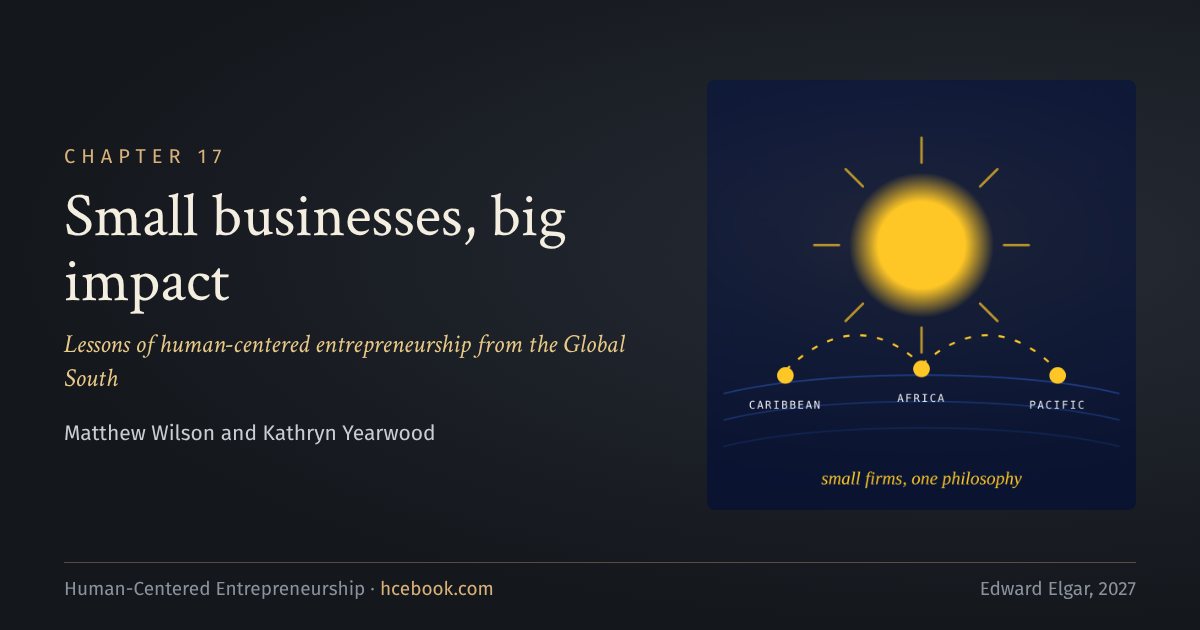
But what are the characteristics that allow these entrepreneurs to be innovators, risk-takers, revolutionaries, and visionaries? What are the qualities, combined with a brilliant idea, that have led some people to step out of their comfort zone into the sometimes lonely world of entrepreneurship?
How do we harness this spirit, not just for profit, but also for good? How can we find that balance between the success of a business based on profit and the prioritization of human dignity, well-being, and sustainable development?
How do we harness this spirit, not just for profit, but also for good?
Four small firms in Africa, the Caribbean, and the Pacific show that purpose and profit can share one business.
Read chapter 17 →
The purpose of life is not to be happy. It is to be useful, to be honorable, to be compassionate, to have it make some difference that you have lived and lived well.Ralph Waldo Emerson
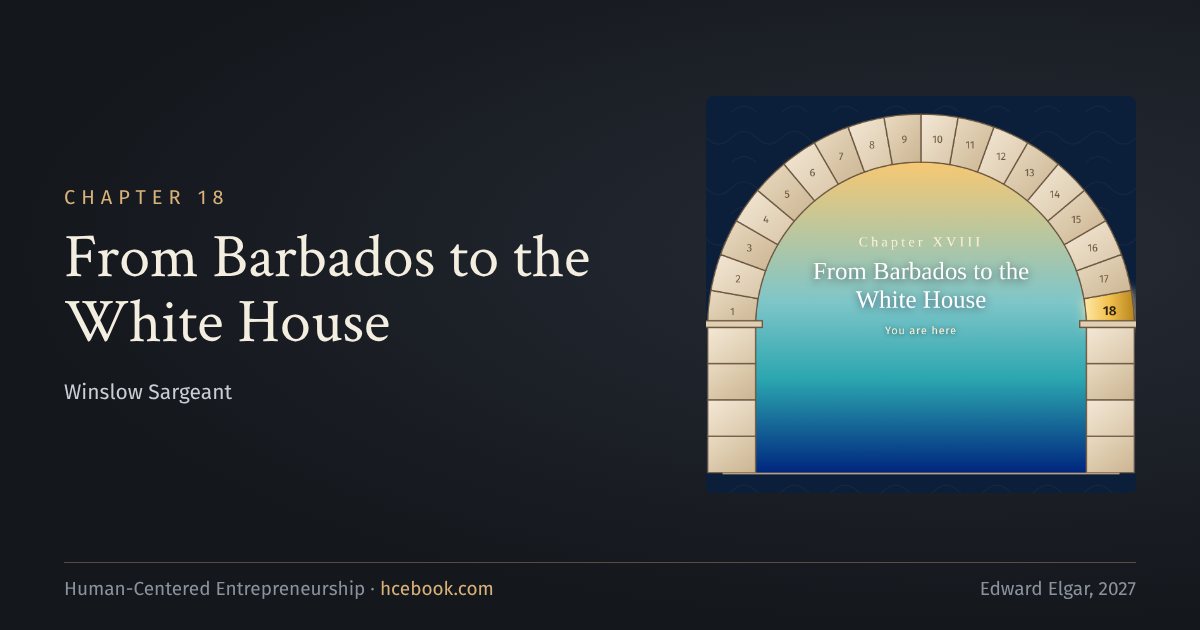
I was born in Marchfield, in the parish of St. Philip on the eastern side of Barbados, and I left the island when I was seven years old. But Barbados has never left me. I still have vivid memories of those early years—a childhood rich in freedom and the kind of creativity that comes from having very little and making a great deal out of it. We built our own games. We invented things from whatever we could find.
My siblings and I once attempted to build a miniature canal system in the yard, carving channels into the earth, watching how water moved through them, and adjusting the design when it did not behave the way we expected. Looking back, it was a systems experiment. At the time, it was play. But those two things have never been entirely separate for me.
What Barbados gave me, before anything else, was curiosity. It also gave me an understanding of warmth—the warmth of people who take a genuine interest in one another, who have conversations that go somewhere, and who look after each other as a matter of course rather than obligation. I have returned many times as an adult, and each visit reminds me of that culture of attention and presence.
The wind hit me like a wall the moment I stepped off the plane at Logan Airport. I had never been cold before. I was seven years old, wearing a light jacket, arriving from an island where the temperature rarely drops below 77 degrees. It was, in its own way, a clarifying moment. The world was going to require figuring out.
We do not need to raise the roof. We need to raise the floor.
Read chapter 18 →All eighteen chapter openings in one PDF.
Download the preview edition PDF · 26 pages